Let’s be honest, the humble electric kettle is one of the unsung heroes of the modern kitchen. That satisfying click as it switches off, promising a perfect cup of tea or a head start on your pasta—it’s a sound of comfort and convenience. But have you ever paused, mid-pour, and wondered about the electric kettle electricity usage per boil? What is that quick, steamy burst of power actually costing you? You’re not alone. Understanding this is the first step to becoming a smarter consumer, saving a few bucks, and even being a little kinder to the planet.
Welcome to Electric Kettle Best, where we obsess over these details so you don’t have to. I’ve spent years testing, tinkering with, and, yes, descaling more kettles than I can count. Today, we’re pulling back the curtain on one of the most common questions we get. We’ll break down the science in simple terms, show you how to calculate your own costs, and share some insider tips to make your daily brew more efficient than ever.
What Actually Determines Your Kettle’s Energy Use?
Before we can talk numbers, we need to understand the key players in this energy equation. It’s not just about flipping a switch; a few simple factors dictate how much power your water boiler is actually drawing from the wall. Think of it like a recipe—you need the right ingredients to get the final result.
Decoding the Numbers: Wattage and Time
First up is wattage (W). This is the raw power of your kettle’s heating element. You’ll usually find this printed on the base of the appliance or in its manual. Most kettles in the US fall between 1200W and 1500W, while in the UK and other 230V regions, they can go up to 3000W.
Think of it this way: Wattage is like the horsepower of a car. A higher wattage kettle (a 3000W model) will boil water much faster than a lower wattage one (a 1200W model), just like a sports car accelerates quicker than a family sedan.
But here’s the twist: while a high-wattage kettle uses more power per second, it runs for a much shorter time. The end result in terms of total energy consumed is often surprisingly similar. The real variable isn’t just power, but power over time.
The “How Much Water” Factor
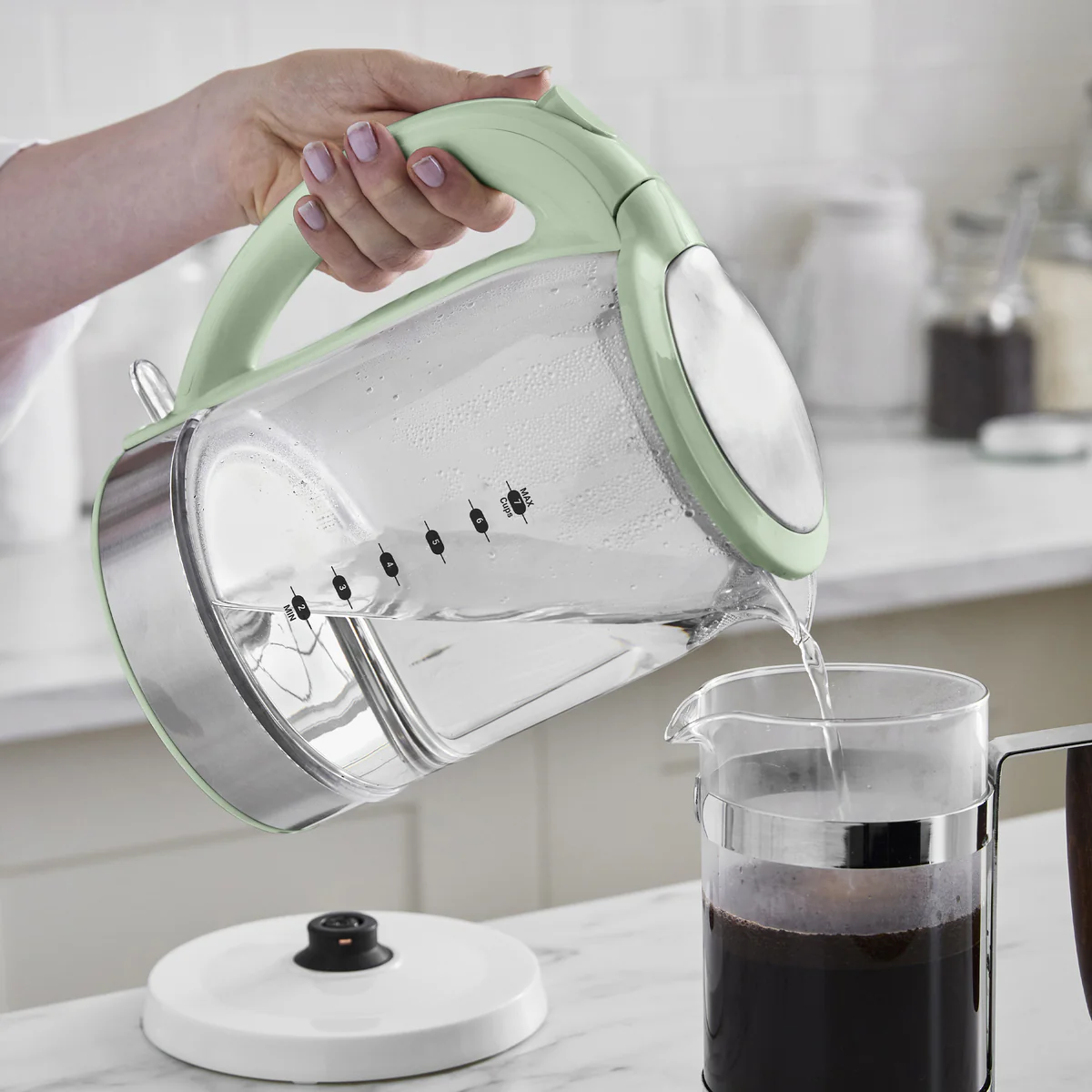
This is the single biggest energy-waster I see in kitchens everywhere. My old college kettle didn’t have a water-level window, so I’d just fill it up to the top every single time, even if I only wanted one cup of tea. I was essentially boiling three or four cups’ worth of water for no reason.
Heating water is an energy-intensive process. Heating more water takes proportionally more energy and more time. The most effective way to reduce your electric kettle’s energy consumption is beautifully simple: only boil the amount of water you actually need.
Let’s Do the Math: Calculating Your Electric Kettle Electricity Usage Per Boil
Okay, time to get practical. You don’t need to be an electrical engineer to figure this out. With a little information, you can get a very accurate estimate of what each boil costs you.
Here is a simple, step-by-step guide:
- Find Your Kettle’s Wattage: Check the bottom of the kettle or its power base. Let’s use a common US example: 1500 Watts.
- Time the Boil: Using a stopwatch (your phone works perfectly), time how long it takes to boil a specific amount of water—say, 1 liter (about 4 cups). For our 1500W kettle, let’s say this takes 4 minutes.
- Convert to Kilowatt-Hours (kWh): Your electricity company bills you in kilowatt-hours (kWh), not watts. The conversion is easy.
- First, convert watts to kilowatts: 1500W / 1000 = 1.5 kW.
- Next, convert minutes to hours: 4 minutes / 60 = 0.067 hours.
- Now, multiply them together: 1.5 kW 0.067 hours = 0.1005 kWh. This is your Electric Kettle Electricity Usage Per Boil* for 1 liter of water.
- Find Your Electricity Rate: Look at your latest utility bill. The price is listed per kWh. The US average is around $0.17 per kWh (as of late 2023), but it varies wildly by state. Let’s use $0.17/kWh for our example.
- Calculate the Cost: Multiply the energy used by your rate: 0.1005 kWh * $0.17/kWh = $0.017.
So, in this example, boiling a liter of water costs you just under two cents. It might not sound like much, but if you’re a household of tea lovers boiling the kettle 5-6 times a day, that adds up to over $40 a year on water boiling alone!
Is My Kettle an Energy Hog? Stovetop vs. Electric
This is a classic kitchen debate. Is it cheaper to boil water in an electric kettle or in a pot on the stove?
The answer, in almost every case, is the electric kettle.
The reason is efficiency. An electric kettle’s heating element is submerged directly in the water. Nearly all of the energy it draws is transferred directly into heating the water. Consumer Reports suggests that electric kettles are typically around 80% efficient.
A stovetop, whether it’s gas or electric, is much less efficient.
- Gas Stovetop: A lot of heat from the flame licks up around the sides of the pot and is lost to the surrounding air. Efficiency can be as low as 40%.
- Electric Stovetop: While better than gas, the burner has to heat itself up first, then transfer that heat to the pot, which then transfers it to the water. Heat is lost at every step. Efficiency is around 70%.
So, while the per-unit cost of natural gas might be lower than electricity, the sheer inefficiency of the process often makes it a more expensive way to boil water.
Smart Features That Can Slash Your Energy Bill
Modern electric kettles are more than just on/off switches. Manufacturers have introduced some brilliant features that give you more control and, when used correctly, can significantly reduce your energy footprint.
- Variable Temperature Control: This is a game-changer, especially for tea and coffee aficionados. Different beverages taste best at different temperatures (e.g., green tea around 175°F/80°C, French press coffee around 200°F/93°C). A variable temperature kettle allows you to heat water to the exact temperature you need, not just a rolling boil (212°F/100°C). Heating water to 80°C instead of 100°C can save up to 20% of the energy.
- Keep Warm Function: This feature maintains the water at a set temperature for a period of time (usually 20-60 minutes). It can be an energy saver if you know you’ll need a second cup shortly after the first. It uses small pulses of energy to maintain heat, which is more efficient than a full re-boil from cold. However, if you don’t use it, it’s just wasted energy.
- Good Insulation: Look for kettles with double-wall construction, often found in stainless steel models. They act like a thermos, keeping the water hotter for longer naturally. This means if you come back for a second cup 10 minutes later, the water will be much hotter than in a single-walled glass or plastic kettle, requiring less energy to bring it back to temperature.
|
Our Picks for the Best Electric Kettle in 2026
As an Amazon Associate, we earn from qualifying purchases.
|
||
| Num | Product | Action |
|---|---|---|
| 1 | OVENTE Electric Kettle, 1.5L Borosilicate Glass Countertop Water Heater and Boiler for Coffee or Tea, BPA-Free, Auto Shut-Off, Boil-Dry Protection, Removable and Washable Spout Filter, Black KG83B |

|
| 2 | Chefman Electric Kettle with Temperature Control, 5 Presets LED Indicator Lights, Removable Tea Infuser, Glass Tea Kettle & Hot Water Boiler, 360° Swivel Base, BPA Free, Stainless Steel, 1.8 Liters |
|
| 3 | Cosori Electric Kettle, No Plastic Filter & Spout, 1.7L Tea Kettle & Hot Water Boiler For Coffee & Tea, Water Heater & Teapot, Automatic Shut Off, Borosilicate glass, Black, 1500W |
|
| 4 | Cuisinart 1.7-Liter Stainless Steel Cordless Electric Kettle with 6 Preset Temperatures |
|
| 5 | Chefman Electric Kettle, 1.8L 1500W, Hot Water Boiler, Removable Lid for Easy Cleaning, Auto Shut Off, Boil-Dry Protection, Stainless Steel Filter, BPA Free, Borosilicate Glass Electric Tea Kettle |
|
| 6 | Chefman Electric Kettle, 1.8L 1500W, Hot Water Boiler, Removable Lid for Easy Cleaning, Auto Shut Off, Boil-Dry Protection, Stainless Steel Filter, BPA Free, Borosilicate Glass Electric Tea Kettle |
|
| 7 | OVENTE Electric Kettle, 1.5L Borosilicate Glass Countertop Water Heater and Boiler for Coffee or Tea, BPA-Free, Auto Shut-Off, Boil-Dry Protection, Removable and Washable Spout Filter, Black KG83B |
|
| 8 | Amazon Basics Electric Kettle with Glass Carafe for Tea and Coffee, BPA-Free, Fast Boiling, Auto Shut-Off, 1.8 Quarts, 1500W, Black and Silver |
|
| 9 | Amazon Basics Electric Stainless Steel Kettle for Tea and Coffee, BPA-Free, Fast Boiling, Auto Shut-Off, 1.1 Quarts, 1500W, Black and Silver |
|
| 10 | Chefman Electric Kettle with Tea Infuser, 1L 1500W, Removable Lid for Easy Cleaning, Boil-Dry Protection, Stainless Steel Filter, BPA Free, Auto Shut Off Hot Water Boiler, Small Electric Tea Kettle |
|
As product design engineer Dr. Eleanor Vance notes, “The biggest unseen energy loss in kitchen appliances is waste heat. A well-insulated, double-walled kettle isn’t just a safety feature to prevent burns; it’s an efficiency feature. It keeps the energy where you want it: in the water.”
Practical Tips to Lower Your Kettle’s Running Costs
Beyond buying a new model, there are simple habits you can adopt right now to lower your kettle’s energy bill.
- Boil Only What You Need: We’ve said it before, but it’s the golden rule. If you need one cup, boil one cup. Use the measurement markers on your kettle.
- Descale Regularly: If you live in a hard water area, you’ll see a chalky white buildup called limescale inside your kettle. This is a big problem. Limescale is a terrible conductor of heat, forming an insulating layer over the heating element. Your kettle has to work much harder and longer to heat the water through that scale, wasting a significant amount of electricity. A simple vinegar or citric acid descale every month or two will keep it working at peak efficiency.
- Choose the Right Size: If you live alone, a giant 1.7-liter family-sized kettle might be overkill. A smaller 1-liter model can help encourage you to boil less water each time.
- Don’t Re-boil Immediately: If you just boiled the kettle five minutes ago, the water is still very hot. It will take a fraction of the time and energy to bring it back to a boil compared to starting with cold tap water.
Frequently Asked Questions (FAQ)
Q: What is the average electric kettle electricity usage per boil?
A: On average, a standard 1500W kettle in the US uses about 0.1 kWh to boil 1 liter of water. At an average electricity rate of $0.17/kWh, this costs just under 2 cents per boil. This can vary based on your kettle’s power and local energy costs.
Q: Is a higher wattage kettle more energy efficient?
A: Not necessarily. A higher wattage kettle boils water faster but draws more power while it’s on. A lower wattage kettle is slower but draws less power. The total energy (kWh) used for the same amount of water is often very similar. The main benefit of high wattage is speed, not efficiency.
Q: Does using a gooseneck kettle for pour-over coffee use more electricity?
A: Generally, no. The electric kettle electricity usage per boil is determined by wattage and volume, not the shape of the spout. A 1500W traditional kettle and a 1500W gooseneck kettle will use the same energy to heat the same amount of water to the same temperature.
Q: How often should I descale my kettle to save energy?
A: This depends on your water hardness. In a hard water area, descaling every 1-2 months is a good practice to maintain efficiency. If you notice a white, flaky buildup on the heating element or the boil time seems longer than usual, it’s definitely time to descale.
Q: Is it cheaper to boil water in the microwave or an electric kettle?
A: The electric kettle is almost always cheaper and more efficient. Microwaves are only about 50% efficient at converting electricity into microwaves to heat the water. Electric kettles, with their direct-contact heating elements, are around 80% efficient, making them the clear winner for energy savings.
Your Perfect Cup, Made Smarter
Understanding your electric kettle electricity usage per boil isn’t about pinching pennies until they squeak. It’s about being mindful. It’s about knowing that the small choices we make in our kitchen, from the appliances we choose to the way we use them, have a real impact.
That quick, convenient boil for your morning coffee doesn’t have to be a mystery. By choosing an efficient model, descaling regularly, and, most importantly, only boiling the water you need, you’re not just saving money—you’re making a smarter, more conscious choice. Now, go and enjoy that perfectly brewed cup. You’ve earned it.